
Your plan's cost levers, priced against the market.
Your levers and your dollars in one system. Model what switching carriers would do, see what optimizing the one you have is worth, and learn how to pull each lever. Then measure whether you're capturing the opportunity.
Open Roadmap and click through it yourself.
A guided walkthrough of the same screens a benefits committee and its advisor use, the plan overview, the levers, the actions, and the math behind the numbers.
Built on a synthetic population. No real employer’s plan or member data appears in the demo.
Every screen answers a question you can act on.
Four stops through the operating environment benefits committees and their advisors use to run a self-insured plan, from the plan overview to the execution playbook to the math behind the numbers.
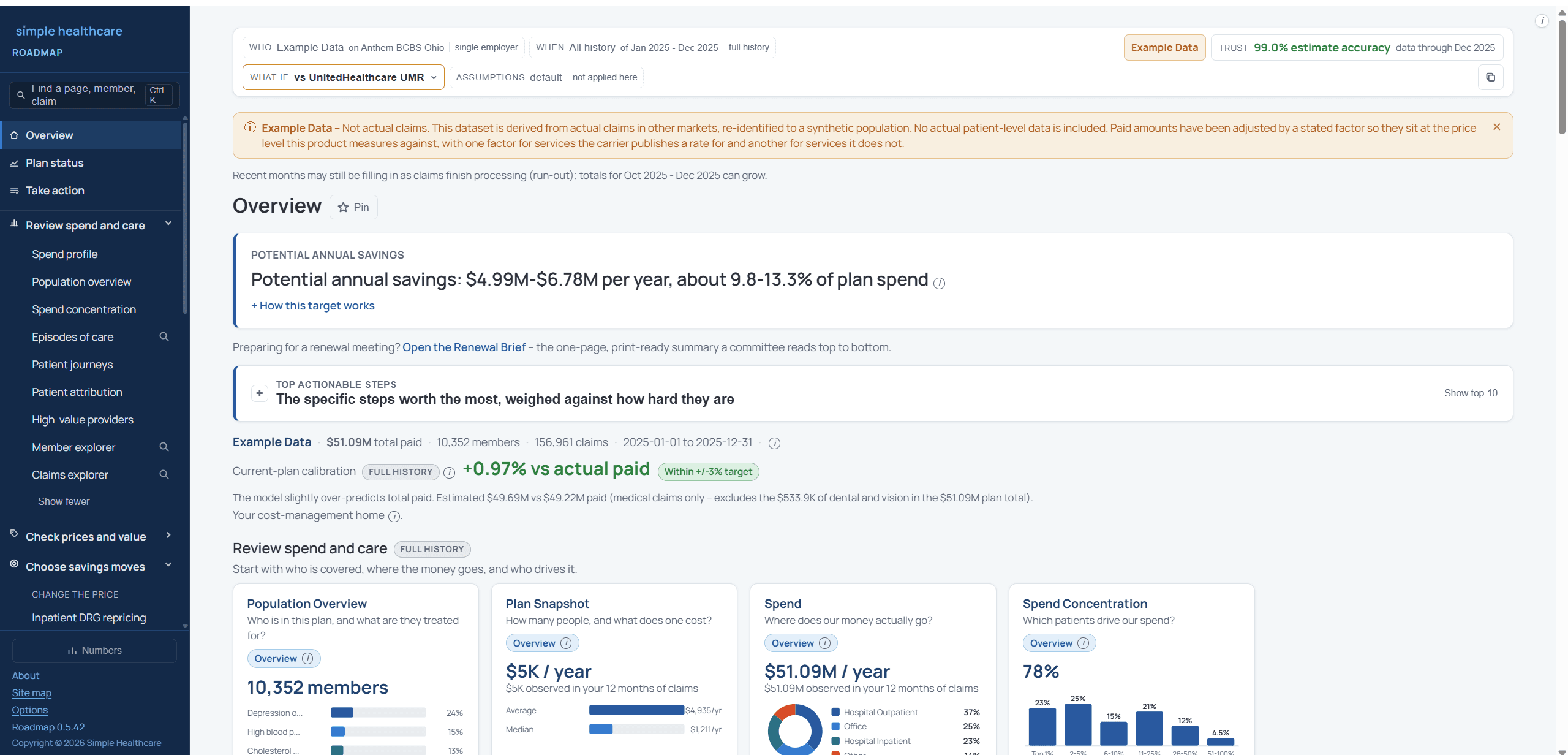
Your whole plan on one screen.
Network pricing, provider prices, DRG and APC repricing, lower-cost sites, referrals, member access, care quality, care outcomes, spend, rate evidence. The whole plan graded on one screen. Click any tile to drop into the full diagnostic behind it.
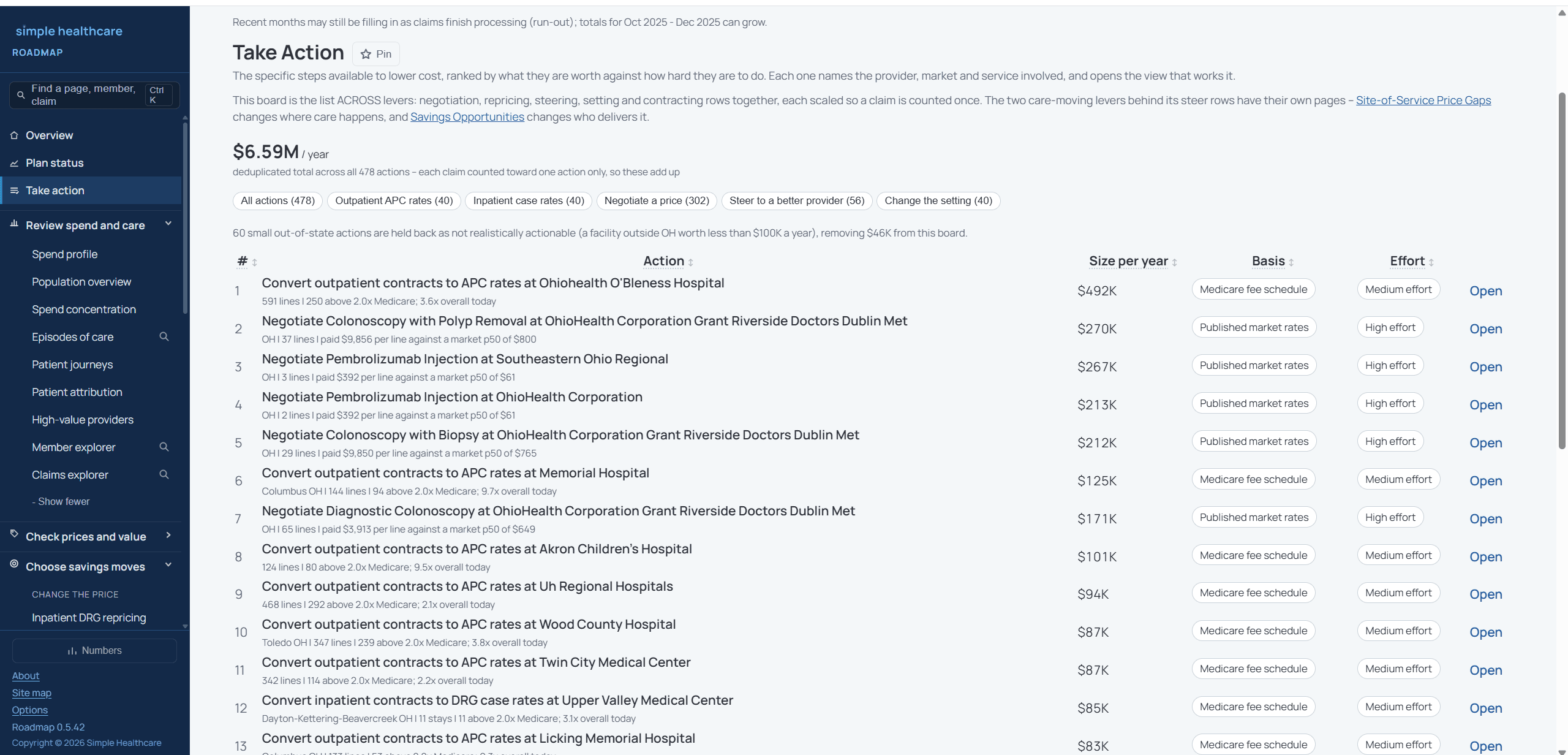
We rank the steps worth the most, and flag the risks first.
The specific steps worth the most, weighed against how hard they are. Each one is named to a contract, a code and a provider, with dollars per year and effort attached. Every step links back to the diagnostic that computed it.
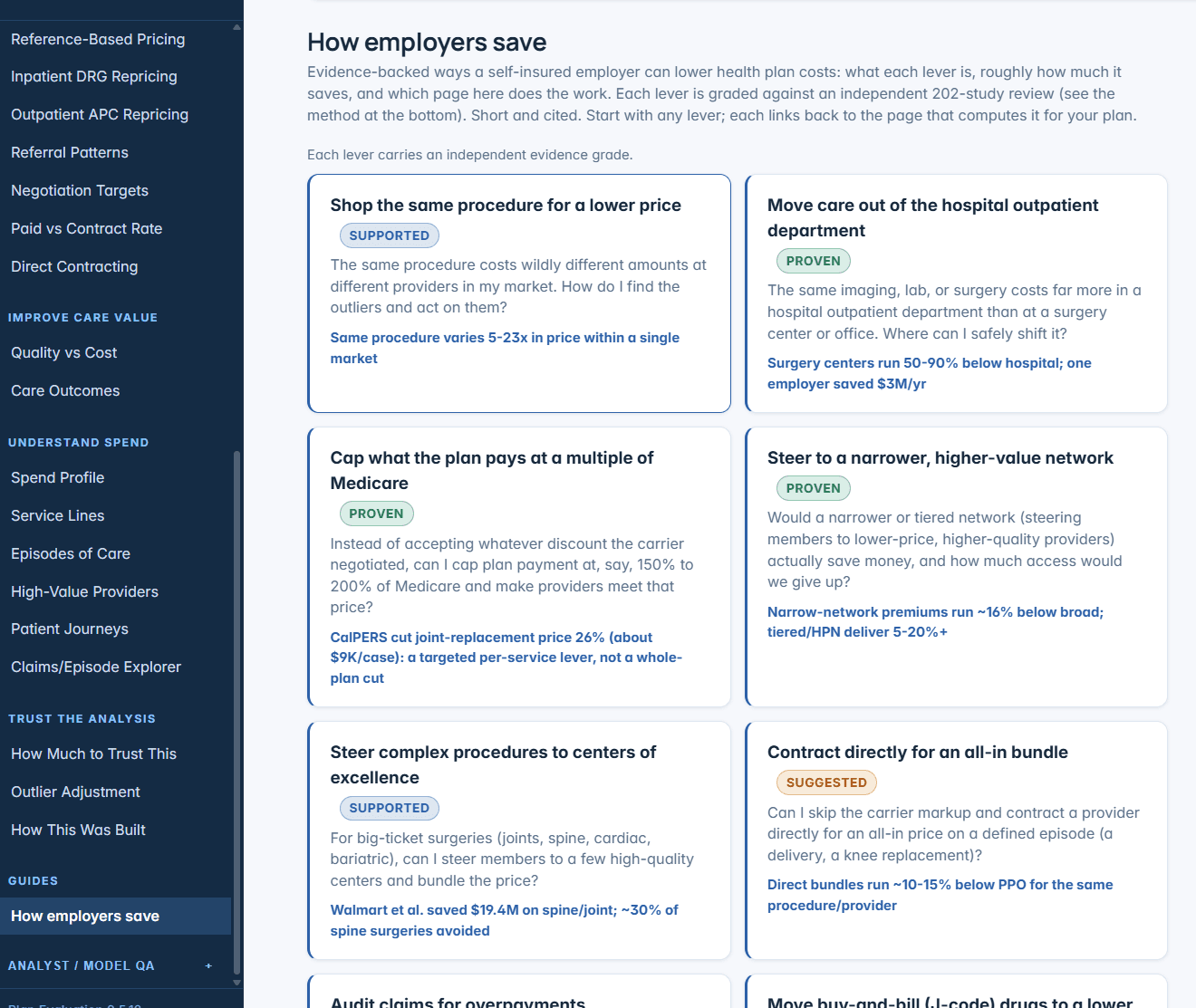
Each lever comes with an evidence-graded playbook.
Reference pricing. Site-of-service shifts. Narrower networks. Direct contracts. Each lever tagged PROVEN, SUPPORTED, or SUGGESTED against an independent research review, and each linked to case studies (CalPERS on joint replacement, Walmart on spine and joint) that show the math working in the wild.
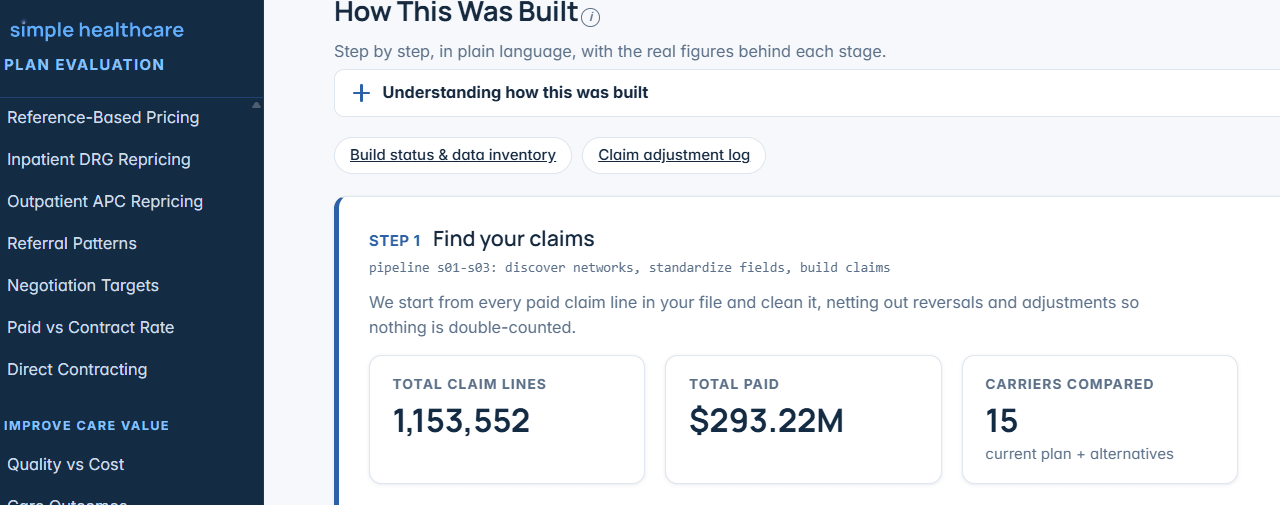
Roadmap shows its own math.
Every claim line traced. Every carrier compared. Every rate priced from a rate insurers and hospitals must publish under federal law, or a validated estimator, with the evidence share disclosed on every screen. Fiduciary trust, earned with receipts, not asked for on faith.
Five layers of the platform.
Roadmap is the working environment your benefits committee and your advisor use together to model, decide, execute and measure. It replaces the annual slide deck with a screen both sides can open at once.
Where the plan stands, on one screen.
One screen the CHRO, CFO, committee, and advisor open together. Cost, coverage, access, quality and evidence. Every tile opens the diagnostic behind it.
- Percent of care in-network and provider count
- Quality-above-market spend flagged by provider group
- Avoidable readmission exposure quantified
- Spend concentration, the top 20% of members driving the plan
Each lever gets its own page, with the dollars worked out.
Carrier decision. Carrier comparison. Network & disruption. Provider retention. Proximity mapping. Targeted savings. Reference pricing. Spend profile. Quality vs. cost. Each is a full diagnostic with evidence grade and modeled impact, all built on the rates insurers and hospitals must publish, joined to full episodes of care, the join that makes reference pricing, DRG repricing, site-of-service, and direct-contracting analysis possible at all.
- Provider-level keep / gain / lose by carrier
- Site-shift, RBP, DRG/APC repricing, direct contracting , each lever priced
- Shoppable reference pricing with plan-savings vs. member-exposure trade-offs
Should you switch carriers, or fix the one you have?
Path A: change carriers. Path B: pull the levers on the current network. Roadmap models both, deduplicated so the total isn't over-counted, with an 18-month window and adjustable adoption, outlier, and OON assumptions.
- Two paths, one comparable number for the committee
- Assumption sliders the actuary and CFO can push on live
- Percent-of-plan-spend framing so the size of the prize is honest
How to pull each lever.
For each lever, three execution paths: do it internally with today's broker + TPA; hire a consultant for design and feasibility; bring in a specialist vendor. Expected cost, effort, and named companies known to do the work.
- Peer-reviewed evidence cited per lever with a PROVEN / SUPPORTED / SUGGESTED grade
- Who operates in each lane, priced against what they would be proposing
- Effort & cost bands so committees pick a path they can execute
Fiduciary trust, earned with receipts.
Roadmap exposes its own math. Every claim on every screen links to the methodology behind it, because a plan fiduciary can't defend a number they can't trace.
- Rate evidence match, how much of paid spend was priced from a real published rate
- Data vintage, the date behind every rate table
- Evidence grade per carrier and per lever (Solid / Caution / Insufficient data)
- Calibration, prediction drift, universe coverage for the underlying models
We don’t recommend vendors. We price what they’re worth on your plan.
Every savings vendor arrives with a number attached, and very few of those numbers were graded by anyone who wasn’t paid on the outcome. Roadmap prices what each lever is actually worth on your own claims, so a proposal can be held up against something independent before you sign it. The companies below are simply who operates in that lane.
Why this can come from us.An execution vendor can’t grade its own savings claim. Neither can the broker who placed it, nor the TPA who administers it, the largest actuarial validation anyone has published in this market was run by a firm that also distributes the vendor it validated. We take no commission, no savings share, and no money from any vendor named here. That’s what leaves us free to tell you a proposal is worth less than it claims, or that you’re already well priced on that lever and should skip it.
Named companies are examples of who operates in this lane, not endorsements, not a ranking, and not a complete market. No vendor pays for placement, and Simple Healthcare takes no compensation from any of them; several now sell analytics that compete with ours, and they’re listed anyway. Roadmap links to each company’s own site, verify current offerings and pricing before you act.
Roadmap spans Plan Level and Strategy Level.
Two diagnostic tiers, one product. Member Level is where Simple Healthcare Search, coming soon, will live.
Which carrier gives us the best cost and access?
Cross-carrier comparison, before the RFP.
What strategies move cost and access?
Evidence-graded levers with execution playbooks.
Turn plan strategy into member choice.
Simple Healthcare Search puts shopping support in members' hands, coming soon.
Beta-tested with four self-insured plan sponsors, from small to large ($426M combined annual spend): $54M in potential savings identified, 13% of combined spend, while preserving network access and minimizing member disruption.
In the platform, that opportunity lands in specific committee decisions: carrier changes tied to network and cost, direct contracts on high-cost episode categories, plan-design changes that shift the site of service, and incentive designs the finance team can defend.
Ready to see your plan’s levers?
Bring a claims feed, leave with a diagnosed plan, two paths modeled in dollars, and an execution playbook the committee can act on next quarter.
Frequently asked questions.
What does Simple Healthcare Roadmap deliver?
A working platform for the self-insured plan: a plan-health overview, a full diagnostic per lever, switch-vs-optimize path modeling in dollars, an execution playbook for each lever, and the receipts behind every number. Medical and specialty pharmacy in one product, built for the committee, the actuary, and counsel.
Is Roadmap Available Now?
Yes. Roadmap is live and in production, beta-tested with four self-insured plan sponsors, from small to large ($426M combined annual spend), identifying $54M in potential savings (13% of combined spend), while preserving network access and minimizing member disruption.
Where do the market rates come from?
From the negotiated rates insurers and hospitals are required to publish under federal transparency rules, cleaned, validated, and joined to full episodes of care, plus Medicare and all-payer claims and hundreds of additional data sources. Every rate on every screen shows whether it came from a published record or a validated estimate.
What data do you need from us to get started?
Your plan's claims feed. Roadmap combines that with the platform's federal Transparency in Coverage files, hospital MRFs, Medicare fee schedules, provider affiliation, and specialty drug pricing data. Every layer is independently verifiable and peer-reviewable. All claims data is anonymized and encrypted at rest and in transit, and handled under a HIPAA business associate agreement with every plan.
What's the timeline from onboarding to first insights?
Typically four to six weeks from claims feed to a diagnosed plan, two paths modeled in dollars, and the levers priced with a ranked list of actions and execution playbooks. The cadence fits the plan-year rhythm, pre-renewal RFP prep, strategy design, committee reviews, and refreshes quarterly between renewals so priorities don't stall.
Do we need to switch carriers to use Roadmap?
No. Roadmap models both paths side by side, switch the carrier, or optimize the current network with levers like site-shift, RBP, direct contracting, and steerage. Many plan sponsors use it to negotiate with the incumbent, or to enter an RFP with the answer already in hand.
What can a committee show from Roadmap?
A record it can defend on its own terms. Peer-reviewable methodology, independent from any carrier or healthcare provider, and outputs the committee packet, actuary and counsel can trace end-to-end. Evidence grades, rate-evidence match rates, calibration and universe coverage are exposed on the same screens the recommendations live on, and Simple Healthcare is paid by the customers who use the platform. What standard applies to your plan is a question for your counsel; what we supply is the evidence.
Does Roadmap work for smaller self-insured plans?
Yes. Roadmap runs on any self-insured population with a claims feed. The diagnostic and lever library scale from mid-market through large enterprise plans; the opportunity ranges on the Savings & Access Continuum reflect that variance.
Where can I see pricing?
Roadmap is priced on a straightforward PEPM model, licensed directly to plan sponsors and to advisor firms, your rate is scoped to your plan in a short call. No carrier or broker kickbacks, no savings share, the clean fiduciary story.